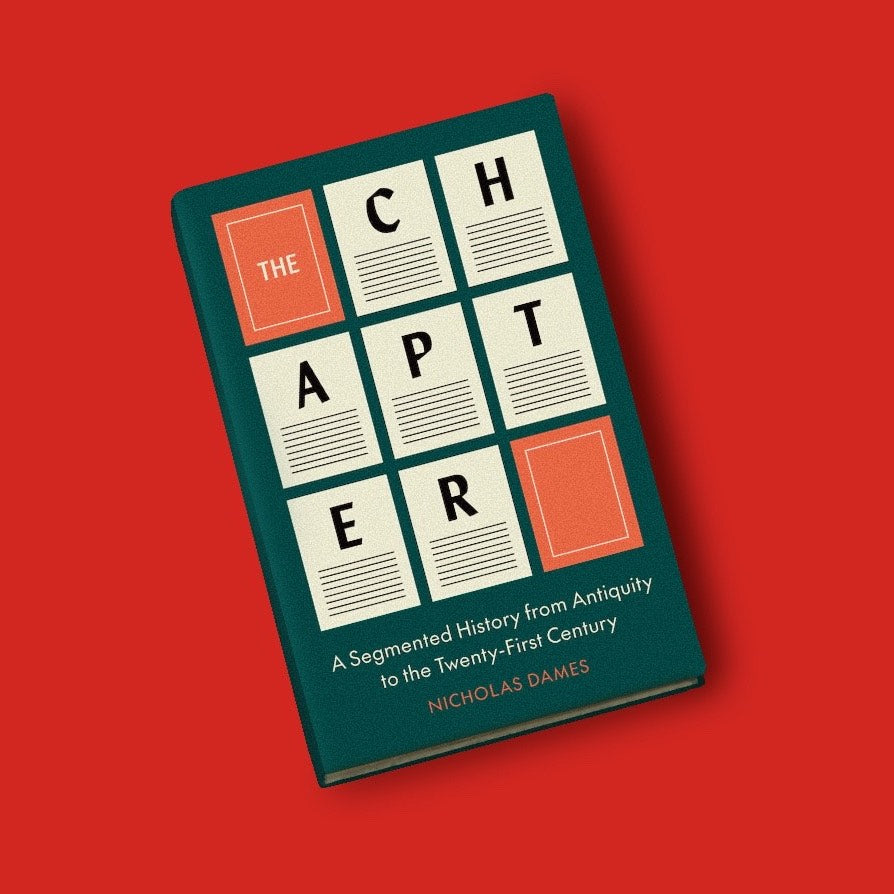
The Chapter, by Nicholas Dames
Couldn't load pickup availability
Why do books have chapters? With this seemingly simple question, Nicholas Dames embarks on a literary journey spanning two millennia, revealing how an ancient editorial technique became a universally recognized component of narrative art and a means to register the sensation of time.
Dames begins with the textual compilations of the Roman world, where chapters evolved as a tool to organize information. He goes on to discuss the earliest divisional systems of the Gospels and the segmentation of medieval romances, describing how the chapter took on new purpose when applied to narrative texts and how narrative segmentation gave rise to a host of aesthetic techniques. Dames shares engaging and in-depth readings of influential figures, from Sterne, Goethe, Tolstoy, and Dickens to George Eliot, Machado de Assis, B. S. Johnson, Agnès Varda, Uwe Johnson, Jennifer Egan, and László Krasznahorkai. He illuminates the sometimes tacit, sometimes dramatic ways in which the chapter became a kind of reckoning with time and a quiet but persistent feature of modernity.
Ranging from ancient tablets and scrolls to contemporary fiction and film, The Chapter provides a compelling, elegantly written history of a familiar compositional mode that readers often take for granted and offers a new theory of how this versatile means of dividing narrative sculpts our experience of time.
Praise for The Chapter
"Dames shows exactly why chapters are worth our attention. . . . A pleasing investigation." —Kirkus Reviews
“The Chapter is that rare thing: a scholar’s book that is at once learned and delightful. Nicholas Dames has written a supple, elegant, unfussy, and wide-ranging history of how the curious practice of dividing prose into its component parts has taught readers to experience the flow of time. From The Chapter and its many masterful theories of narrative measurement, we learn what it is to wait, to hope, to search, to find; to pause, to rest, to breathe.” —Merve Emre, Wesleyan University, contributing writer at The New Yorker
“The Chapter is one of those books whose confidence and sweep—from classical and scholastic literature through to the modern avant-garde—is thrilling. Dames’s elegant close readings are a continual delight, showing how our sense of suspense, or transition, or the containment of time, or of the Jamesian scene, may derive not from the text itself but from its scrupulous segmentation. Under Dames’s careful eye, the chapter is revealed to be a venerable and singularly adaptable literary device, the Swiss Army knife of Western narrative.” —Dennis Duncan, author of Index, A History of the: A Bookish Adventure from Medieval Manuscripts to the Digital Age
“This is the masterwork we did not know we needed, on a topic easy to overlook. What Scott McCloud did for the gutter in comics, Nicholas Dames has done for an equally vital, equally unobtrusive sort of textual pause. Dames’s prose is lucid and elegant while his brilliantly chosen examples are legion without being overwhelming. I will never turn from one chapter to the next in the same way again.” —John Plotz, author of Semi-Detached
Hardcover
384 pages.
